
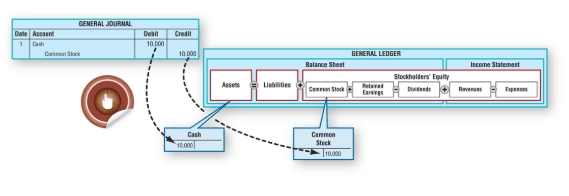
A general journal is the first place where data is recorded, and every page in the item features dividing columns for dates and serial numbers, as well as debit or credit records. The account format used in Panel C of Figure 1 is called a four-column account. The first pair of debit and credit columns contains the individual transaction QuickBooks amounts that have been posted from journal entries, such as the $10,000 debit.
- Together, the journal and the ledger form a robust system for maintaining accurate financial records, ensuring the integrity of financial information, and supporting informed decision-making.
- Comparisons may contain inaccurate information about people, places, or facts.
- There is no reason you should ever need to be able to complete double-entry bookkeeping by hand, on paper.
- The format of a ledger account is ‘T’ shaped having two sides debit and credit.
- When it comes to financial record-keeping, two essential tools that are often used are the journal and the ledger.
Differences Between Journal and Ledger
- The account format used in Panel C of Figure 1 is called a four-column account.
- This article summarizes the differences between journals and ledgers in the form of a comparison chart.
- Additionally, the journal serves as a reference point for posting entries to the ledger.
- This attribute ensures the accuracy and integrity of the financial records, as errors can be promptly addressed before they impact subsequent stages of the accounting process.
- In contrast, the general journal’s structure is characterized by its chronological format, capturing transactions in the order they occur.
- Generally, the ledger account of the ‘T’ form contains eight columns – four in left and four in the right.
The general ledger also enables you to compile a trial balance and helps you spot unusual transactions and create financial statements. Preparing a ledger is important journal vs ledger as it serves as a master document for all your financial transactions. The general ledger also helps you compile a trial balance, spot unusual transactions, and create financial statements. Additionally, the journal serves as a reference point for posting entries to the ledger. It acts as a bridge between the initial recording of transactions and their subsequent classification and summarization in the ledger. Without the journal, it would be challenging to maintain a systematic and organized record of financial transactions.
- One of the key attributes of the journal is its ability to capture the complete transactional details.
- But since we create the trial balance, income statement, and balance sheet from looking at the ledger, it is also so vital.
- Both books of accounts provide a way to record business transactions through the double-entry accounting system via debits and credits.
- On the other hand, the ledger is a summarized version of the journal, where transactions are classified and grouped into specific accounts.
- Together, they ensure accurate financial record-keeping and provide insights into an organization’s financial position.
- Someone on our team will connect you with a financial professional in our network holding the correct designation and expertise.
Recent Posts

Summarize the ending balances from the general ledger and present account level totals to create your trial balance report. The trial balance totals are matched and used to compile financial statements. Debits increase asset and expense accounts and decrease liability, revenue, and equity accounts. Credits increase liability, revenue, and equity accounts and reduce assets and expenses. The ledger might be a written record if the company does its accounting by hand or electronic records when it uses accounting software. According to CPA Practice Advisor, only 18% of small- to medium-sized businesses do not use accounting software.
Can you explain how journals and ledgers differ in terms of their organization and structure?

So, the need for the journal may have been becoming increasingly obsolete in the computerized environment, but it still holds great importance in bookkeeping. When it comes to financial record-keeping, two essential tools that are often used are the journal and the ledger. Both the journal and the ledger play crucial roles in the accounting process, but they serve different purposes and have distinct attributes. In this article, we will explore the characteristics of both the journal and the ledger, highlighting their unique features and how they contribute to maintaining accurate financial records.
Accounting Journals, Ledgers, And Double Entry Explained

Now that we understand the basics of both a general ledger and a general journal, let us refer the infographics below to understand their differences better through the visual representation. The left side is called debit, and the right side is called credit under the “T” format. Our mission is to empower readers with the most factual and reliable financial information possible to help them make informed decisions for their individual needs.
Would you prefer to work with a financial professional remotely or in-person?
Double entry system of bookkeeping says that every transaction affects two accounts. There is a proper procedure for recording each financial transaction in this system, called as accounting process.The process starts from journal followed by ledger, trial balance, and final accounts. Journal and Ledger are the two pillars which create the base for preparing final accounts. The Journal is a book where all the transactions are recorded immediately when they take place which is then classified and transferred into concerned account known as Ledger.
- The ledger shows the account’s opening balance, all debits and credits to the account for the period, and the ending balance.
- It is prepared with the help of a journal itself, therefore, it is the immediate step after recording a journal.
- There is no definitive answer, as both journals and ledgers have their own advantages and disadvantages.
- Generally, when recording transactions in a journal, accountants do not focus on the nature of classification.
- Preparing a ledger is important as it serves as a master document for all your financial transactions.
- The general ledger serves as the backbone of an organization’s financial record-keeping system, providing a comprehensive repository for all financial transactions.
Each transaction recorded in the journal is posted to the appropriate account in the ledger, ensuring that all financial information is properly organized. This classification allows for efficient tracking of account balances and the preparation of financial statements. The journal, also known as the book of original entry, is the first place where financial transactions are recorded. It serves as a chronological record of all business transactions, providing a detailed account of each transaction as it occurs. The journal is typically organized in a sequential order, with each entry containing the date, description, and amount Bookstime of the transaction.

Difference between Journal and Ledger
Once transactions have been entered in the general journal, the information is then transferred to the general ledger. The process of transferring information from the general journal to the general ledger is called posting. Understanding the distinction between a general ledger and a general journal is essential for anyone involved in accounting. These two components are fundamental to accurate financial record-keeping, each playing a unique role within an organization’s accounting system.